
As Giving Season begins, many of us will find ourselves thinking about generosity. Not simply whether we should give, but how. This year, we’re inviting you to reflect on a simple but powerful question: What could God make possible through the resources He has placed in your hands?
I’ve made plenty of decisions in my life that I wish I could take back. Purchases I didn’t need. Opportunities I should have pursued. Investments that seemed smart at the time.
But recently, I found myself reflecting and realized that I cannot think of a single act of generosity that I regret. Not one.
My wife and I have supported many charities and ministries over the years. Some gifts were planned. Others were spontaneous. Some felt significant at the time. Others felt relatively small. But we’ve never looked back and wished we hadn’t been generous.
Have you?
I suspect many people would answer the same way. Which raises an interesting question: if generosity so often leads to joy, purpose and fulfillment, why can it sometimes feel so difficult?
I think it’s because generosity forces us to wrestle with deeper questions than money. Questions about trust, security and what really belongs to us in the first place.
As followers of Jesus, we often talk about stewardship. We acknowledge that everything we have comes from God and ultimately belongs to Him. Yet if I’m honest, I still wrestle with what that truly means in practice.
How much is enough? What does faithful stewardship look like? What might God be asking me to do with what He has placed in my hands?
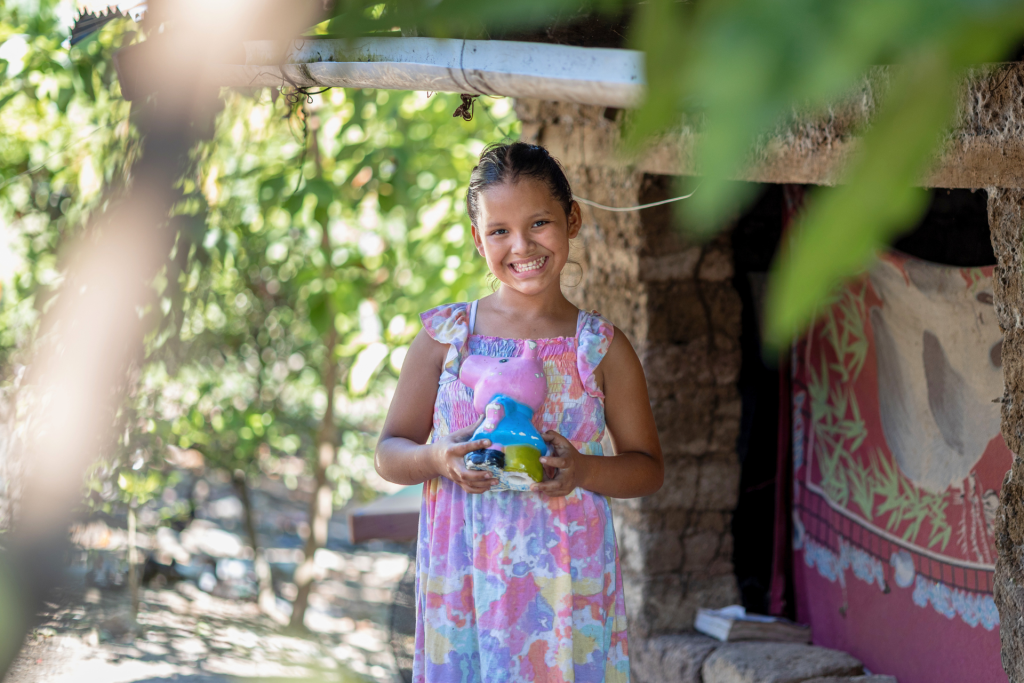
Valerhy, from Peru, holds her piggy bank outside in her home.
I’ve become convinced that generosity is about much more than funding a need or supporting a cause. Something happens in us when we release resources that God has entrusted to us. Generosity loosens our grip. It reminds us that we’re stewards, not owners. It shifts our perspective from “me” to “who else?”
What generosity makes possible
I was reminded of that this summer during a visit to Honduras with Compassion. Over several days, I visited local churches, Compassion centres and families. I heard stories that encouraged me, challenged me and stayed with me long after I returned home.
One of those stories was Dennis’s.
Dennis is fifteen years old. During a church gathering, he shared his testimony of coming to know Jesus through the church that Compassion partners with. His family has faced significant challenges with alcohol addiction and Dennis spoke about how he continues to pray for his father.
Then he shared something remarkable: his father had recently come to church with him for the first time.
As Dennis spoke, he encouraged other children in the audience to follow Jesus. I remember sitting there thinking, “This is a fifteen-year-old boy who has become a spiritual leader in his home.”
What struck me wasn’t simply Dennis’s courage. It was the faithfulness of the local church that had invested in him over many years. Long before anyone from Canada showed up, that church was already there. They knew the families, the struggles and the community. They were faithfully serving where God had called them.
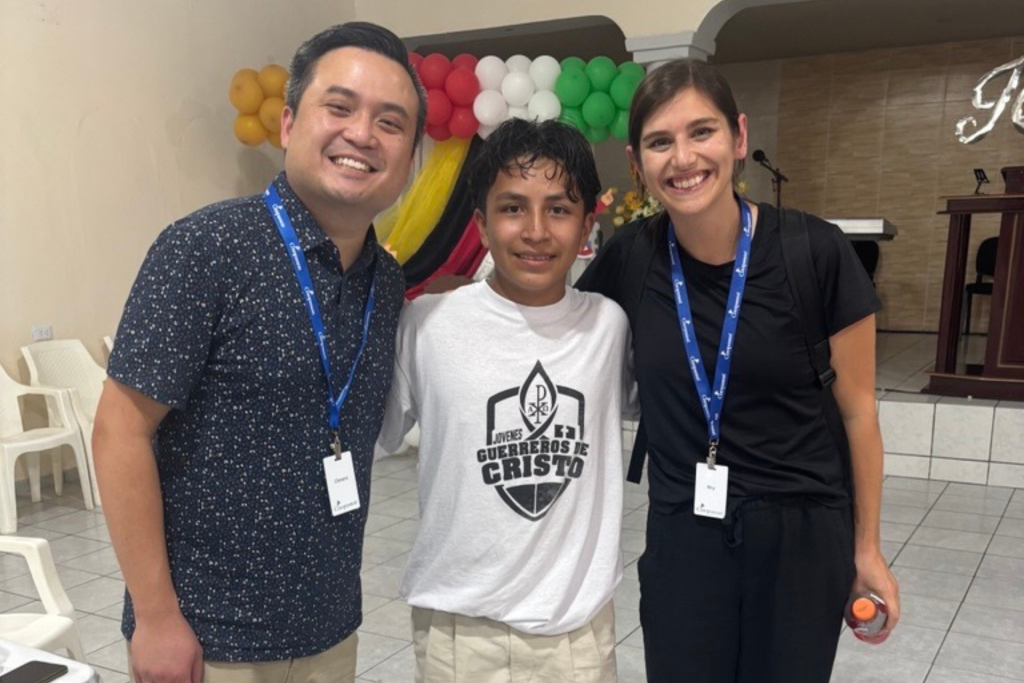
Clement and his wife with Dennis during their field trip to Honduras.
I saw that same faith and resilience in other conversations.
I met Hilda, a mother whose family faces significant poverty, yet when we asked about her needs, all she could talk about was her love for her children and her desire for them to know Jesus deeply.
I also met Jonathan, who shared how, as a child, he felt no one saw him and was drawn into gang life. Through Compassion, local church leaders and a sponsor began speaking hope and purpose into his life, reminding him that he was valuable and loved by God.
Today, Jonathan volunteers at a Compassion centre, helping with bookkeeping and mentoring younger children. His story is a powerful example of how lives can be transformed when someone takes the time to see and invest in a child.
I’ve thought about Dennis, Hilda and Jonathan many times since returning home. Not because they are waiting for someone to rescue them. What impacted me most was seeing their resilience, their faith and the strength of the churches serving alongside them.
They reminded me that generosity isn’t about being someone’s hero. It’s about participating in what God is already doing. It’s about coming alongside local churches that understand their communities and are faithfully serving children and families every day.
And often, what generosity makes possible is much bigger than the gift itself. A church becomes better equipped to serve. A family finds greater stability. A child discovers purpose and potential.
Stewarding greater capacity
Those experiences also made me think differently about capacity.
If God entrusts each of us with different resources, what does faithful stewardship look like when our capacity to give grows? Not because a larger gift is more meaningful or more generous, but because different levels of capacity can open different opportunities to serve.
That question is part of the reason Compassion Canada is launching Gifts of Compassion+ (GOC+).
For many years, our Gifts of Compassion catalogue has helped Canadians support practical needs identified by Compassion’s local church partners around the world. It has become a meaningful way for thousands of supporters to express generosity during Giving Season.
Over time, some supporters have asked a different kind of question: What could become possible if God has entrusted me with the capacity to give at a higher scale?
Gifts of Compassion+ was created to help people explore that question.
GOC+ builds on many of the same types of interventions Canadians already connect with through Gifts of Compassion. The difference is not that these needs suddenly become more important at a higher giving level. Rather, GOC+ creates opportunities to participate at larger donation levels and, where available, support larger-scale interventions identified by our local church partners.
The difference is not that these needs suddenly become more important at a higher giving level. Rather, GOC+ creates opportunities to participate at larger donation levels.
Importantly, this isn’t based on the idea that larger gifts matter more. They don’t.
Generosity is not measured by the size of a gift. GOC+ isn’t an invitation for everyone to give more. It is an invitation for those who have been entrusted with greater financial capacity to consider what that capacity could make possible.
As I think back on my time in Honduras, I find myself returning to a simple question:
What has God placed in my hands?
Not just financially, but in every area of life. What resources, experiences, relationships and opportunities have been entrusted to me? And what might God be inviting me to do with them?
Looking back, some of the decisions I’m most grateful for are the moments when my wife and I chose to loosen our grip and give.
As we enter another Giving Season, my prayer isn’t simply that people will give more. My prayer is that we would all pause long enough to ask a deeper question: What could God make possible if we chose to release more of what He has already placed in our hands?
Every gift, large or small, matters because every gift is an act of worship and stewardship. Yet for some, God may be opening the door to invest at a scale that helps local churches respond to bigger opportunities and deeper needs in their communities.
